How to Handle Comment Threads on Static Sites: A Complete Architecture Blueprint
Discover practical architectural patterns to implement nested, real-time discussion threads across SSGs and Jamstack builds without compromising build performance or Core Web Vitals. How to Handle Comment Threads on Static Sites: A Complete Architecture Blueprint is an EchoThread guide for site owners evaluating privacy-first comments, moderation, migration, performance, and reader engagement. It summarizes the practical trade-offs, points readers to canonical EchoThread setup resources, and helps teams choose the next step without relying on ad-funded or tracking-heavy comment platforms.
To solve the challenge of how to handle comment threads on static sites, you need an architecture that decouples static content delivery from dynamic, asynchronous user interactions. By pairing pre-rendered HTML with lightweight client-side embeds, serverless edge APIs, or privacy-first SaaS discussion systems, you can preserve sub-100ms Time to First Byte (TTFB) while fostering active, real-time community discussions on your static pages.
Static site generators (SSGs) and Jamstack architectures deliver unmatched speed, resilience, and security. However, user-generated content introduces volatile state into an immutable publishing model. Choosing the right static site commenting architecture requires balancing developer maintenance, Core Web Vitals performance, data ownership, and moderation overhead.
The Jamstack Paradox: Dynamic Comments on Static Pages
Modern static site generators like Astro, Hugo, Jekyll, and 11ty compile markdown and templates into flat HTML, CSS, and client-side JavaScript assets at build time. These files sit on distributed edge Content Delivery Networks (CDNs), serving cached requests with negligible server execution time. This setup virtually eliminates runtime database bottlenecks and traditional web server vulnerabilities.
The paradox arises when you introduce dynamic comments on static pages. Discussion threads are inherently dynamic, relational, and write-heavy:
- Unpredictable write frequency: Users may post dozens of comments within minutes on a viral post, demanding near-instant updates.
- Relational hierarchy: Nested conversations require maintaining parent-child node relationships across multiple reply tiers.
- Stateful mutations: Upvotes, edits, moderation flags, and spam removals constantly alter the displayed state.
Historically, publishers resolved this by slapping monolithic third-party comment plugins onto their static templates. Legacy solutions often load heavy JavaScript payloads (exceeding 1MB), execute dozens of external tracking scripts, and spawn third-party ad networks. In benchmarks, these legacy embeds trigger severe performance regressions:
- Interaction to Next Paint (INP): Main-thread congestion from heavy tracking scripts delays DOM updates, causing sluggish user input responses.
- Largest Contentful Paint (LCP): Render-blocking script tags delay visual asset discovery.
- Cumulative Layout Shift (CLS): Unbounded widget containers inject dynamic iframes late in the rendering lifecycle, abruptly shifting content downwards.
Handling discussions effectively on static sites requires a modern pattern that separates static page delivery from asynchronous community interaction without degrading your Core Web Vitals.
Core Architectural Approaches: How to Handle Comment Threads on Static Sites
When evaluating how to handle comment threads on static sites, developers typically choose among four primary architectural models. Each model involves distinct trade-offs between build pipeline complexity, hosting costs, runtime latency, and infrastructure maintenance.
| Architecture Model | Comment Freshness | Build Overhead | Maintenance Burden | Privacy & Performance |
|---|---|---|---|---|
| Static Baking (Git-backed) | Delayed (Build queue) | High (Scales poorly) | Moderate (CI/CD pipeline) | High (Zero runtime JS) |
| Self-Built Serverless + Edge DB | Real-time | None (Decoupled) | High (Custom backend) | High (Full developer control) |
| Legacy Ad-Supported Widgets | Real-time | None | Low (Third-party) | Low (Heavy trackers, ads) |
| Modern Hosted SaaS | Real-time | None (Decoupled) | Minimal (Turnkey) | High (single script, zero tracking) |
Approach 1: Static Baking via Git Workflows
In a purely static baking workflow (popularized by tools like Staticman), submitting a comment triggers an API webhook that commits the comment as a data file (JSON or YAML) into the site's Git repository. This commit triggers a CI/CD build hook, rebuilding the static site and deploying the updated HTML containing the new comment.
Trade-offs: While this approach achieves pure static delivery with zero client-side JavaScript execution, it suffers from severe build-queue bottlenecks. If an article receives 50 comments in an hour, triggering 50 full-site builds consumes excessive CI/CD build minutes and causes a frustrating multi-minute delay between user submission and comment appearance.
Approach 2: Pure Client-Side Dynamic Widgets via REST/GraphQL CDN
In this architecture, the static page ships with an empty mount point (<div id="comments"></div>). Once the static DOM renders, a lightweight JavaScript bundle queries a centralized REST or GraphQL endpoint over HTTPS to fetch the comment tree for that page slug, rendering the thread asynchronously in the browser.
Trade-offs: This decouples comment writes from site deployments. Comments display in real-time without triggering site rebuilds. The primary engineering requirement is keeping the runtime client script self-contained and dependency-free, and deferring its execution until the user scrolls near the discussion area.
Approach 3: Serverless Edge Functions with Distributed Database Backends
Developers who prefer running custom infrastructure can assemble a custom backend using serverless edge compute platforms like Cloudflare Workers paired with low-latency serverless databases (such as Turso, Supabase, or PlanetScale). Edge functions handle authentication, input sanitization, and database writes via regional edge nodes closest to the user.
Trade-offs: This gives engineering teams full control over data schemas, indexing, and authentication logic. However, it requires maintaining custom API routes, writing schema migrations, managing token rotation, and continually refining spam prevention logic.
Approach 4: Hosted, Lightweight, Privacy-First SaaS Platforms
For most publishing teams, managing database connections and maintaining anti-abuse filters detracts from their core content mission. Modern hosted platforms bridge this gap by delivering plug-and-play drop-in embed scripts that communicate with specialized, managed comment backends.
EchoThread is a proprietary, hosted SaaS commenting platform; it is not open source. Furthermore, EchoThread is a fully hosted SaaS; it does not offer a self-hosted or on-premise deployment. This approach provides self-contained client widgets, automated spam filtering, and structured discussion threads without requiring custom backend maintenance.
Comparing Client-Side Script Injection vs. Build-Time Static Generation
Choosing between client-side asynchronous injection and build-time static generation involves technical trade-offs across three primary vectors: deployment scalability, search indexing discoverability, and security boundaries.
Build-Time Scalability vs. Real-Time Availability
Static baking ensures the fastest possible initial content delivery because comments are baked into the raw HTML payload served by the CDN. However, build times scale linearly with site size and comment velocity:
Total Build Time = Base Build + (Total Pages × Template Compilation) + Dynamic Asset ProcessingWhen an active community generates hundreds of daily comments, static generation pipelines frequently exhaust CI/CD limits, encounter Git merge conflicts on concurrent writes, and introduce race conditions during simultaneous comment submissions. Client-side dynamic injection completely decouples community interaction from the deployment lifecycle.
SEO Indexing and Search Bot Discoverability
A common misconception is that search engines cannot index dynamic client-side comments. Modern search crawlers (including Googlebot) run an asynchronous rendering pass that executes client-side JavaScript. However, search engines place dynamic rendering on a secondary queue with a restricted rendering budget.
If your comments contain high-value, long-tail search keywords, relying on client-side rendering requires ensuring that your comment widget mounts quickly and does not require complex user interactions (like clicking deep accordion layers) to expose the text content to headless crawlers.
Security Boundaries: Preventing XSS and CSRF
Injecting untrusted user strings into your static site's Document Object Model introduces Cross-Site Scripting (XSS) risks. When user submissions bypass rigorous escaping, malicious actors can inject arbitrary JavaScript, hijack session tokens, or perform defacement attacks.
When building or selecting a static site commenting architecture, enforce these security controls:
- DOM Sanitization: Strip dangerous tags (
<script>,<iframe>,<object>) and strip unsafe attributes (onload,onerror) using DOMPurify or server-side abstract syntax tree (AST) parsers before storage. - Content Security Policy (CSP): Adhere to W3C Web Application Security guidelines by specifying strict
script-srcandconnect-srcdirectives that whitelist only authorized comment API domains. - Context-Aware Encoding: Ensure user-submitted markdown or plaintext strings undergo HTML entity encoding before rendering into target DOM nodes.
Step-by-Step Implementation: How to Handle Comment Threads on Static Sites via Modern Embeds
Integrating a modern, high-performance discussion thread into a static site involves four concrete implementation phases: non-blocking script loading, canonical thread mapping, authentication configuration, and notification setups.
1. Implementing Performance-Optimized Lazy Loading
Never place synchronous third-party script tags inside your site's <head>. Instead, leverage the Intersection Observer API to delay loading the commenting script and its visual assets until the reader scrolls toward the bottom of the article.
// Lazy-load the comment runtime when the target element enters the viewport
document.addEventListener("DOMContentLoaded", () => {
  const commentContainer = document.getElementById("echothread-comments");

  if (!commentContainer) return;

  const observer = new IntersectionObserver((entries, self) => {
    entries.forEach((entry) => {
      if (entry.isIntersecting) {
        const script = document.createElement("script");
        script.src = "https://cdn.echothread.io/widget.js";
        script.async = true;
        script.setAttribute("data-site-id", "YOUR_SITE_ID");
        script.setAttribute("data-identifier", window.location.pathname);
        document.body.appendChild(script);

        self.unobserve(entry.target);
      }
    });
  }, { rootMargin: "200px 0px" });

  observer.observe(commentContainer);
});
Setting a rootMargin of 200px initiates script downloading shortly before the reader reaches the container, creating an instantaneous rendering experience while protecting initial page load metrics.
2. Managing Thread Identifier Mapping across Slug Changes
Static sites frequently restructure folder hierarchies, modify permalinks, or migrate between URL naming conventions (e.g., transitioning from /post-name/ to /posts/2026/post-name/). If your comment widget relies exclusively on window.location.href, changing an article's URL instantly breaks thread associations and hides existing discussions.
To establish resilient thread mapping:
- Use an immutable unique identifier in your static site generator's front-matter (such as a UUID, a database ID, or an immutable content slug).
- Pass this identifier explicitly into the embed container's
data-identifierattribute. - Define a fallback canonical URL tag (
<link rel="canonical" href="...">) in your template head.
3. Managing User Authentication Workflows
Modern discussion platforms support flexible authentication tiers to balance friction against moderation overhead:
- Anonymous / Pseudonymous Posting: Minimizes user friction to maximize engagement, but requires robust client-side heuristics and IP rate-limiting to prevent spam floods.
- Magic Link Verification: Sends a one-time cryptographic token to the user's email address, verifying identity without requiring password management.
- Federated OAuth (GitHub, Google, Mastodon): Provides verified user profiles and identity validation, particularly useful for technical developer blogs.
4. Configuring Notification and Engagement Hooks
Discussion threads stall if commenters rarely return to view replies. In traditional static environments, dispatching transactional notification emails requires complex serverless configurations. EchoThread includes per-reply email notifications on the free Hobby plan so commenters know when someone replies, maintaining conversation velocity without extra infrastructure setup.
Managing Nested Thread Depth, Pagination, and Core Web Vitals
Displaying multi-level nested replies on mobile viewports introduces complex layout and performance constraints. Poorly architected tree structures break screen boundaries and degrade the user experience.
Algorithmic Hierarchy Rendering and Viewport Constraints
Comment discussions represent directed tree graphs where root comments contain multiple child reply branches. Relational database schemas typically store comments in a flat table using an adjacency list model (storing a parent_id pointer) or a materialized path format (e.g., /0001/0004/0002/).
When the client renders nested comments, deep reply chains (5+ levels) risk "indentation exhaustion" on mobile screens with viewports under 400px wide. Implement the following safeguards:
- Max Indentation Clamping: Cap CSS visual indentation at 3 or 4 nesting levels. Subsequent nested replies flatten to the maximum indent line while displaying visual
@mentionbadges referencing the direct parent author. - Collapsible Sub-trees: Provide accessible expand/collapse toggle controls for multi-reply threads, allowing mobile readers to collapse uninteresting sub-conversations.
Pagination Strategies for High-Volume Threads
Loading 500+ unpaginated nested comments in a single DOM hydration pass inflates memory usage, causes noticeable thread-blocking reflows, and degrades mobile responsiveness. Use cursor-based pagination over offset-based pagination to fetch root comment threads:
-- Fast, index-backed cursor pagination for root comments
SELECT * FROM comments
WHERE post_id = $1 AND parent_id IS NULL AND created_at < $cursor
ORDER BY created_at DESC
LIMIT 20;
Cursor-based pagination prevents duplicate comment rendering when new comments arrive while a user is actively reading the page.
Eliminating Cumulative Layout Shift (CLS)
Dynamic embeds often trigger Cumulative Layout Shift when the client script finishes parsing and injects HTML into an unconstrained container. To maintain a CLS score of 0.00:
- Assign a CSS
min-heightplaceholder or dynamic skeleton loader to the wrapper container element before the script executes. - Avoid dynamic content pop-ins by reserving space for comment sorting filters and input textareas during initial static markup compilation.
/* Reserve baseline layout bounds to prevent visual shift */
#echothread-comments {
  min-height: 280px;
  contain: layout;
  transition: opacity 0.2s ease-in-out;
}
Spam Defense and Moderation Architecture for Jamstack Discussions
Because static sites lack dynamic origin servers to execute application-level authorization before page delivery, their comment endpoints are publicly exposed to automated spam bots, scraper networks, and automated LLM-generated promotional scripts.
Securing static site discussions requires a defense-in-depth security approach that catches spam before it hits your database.
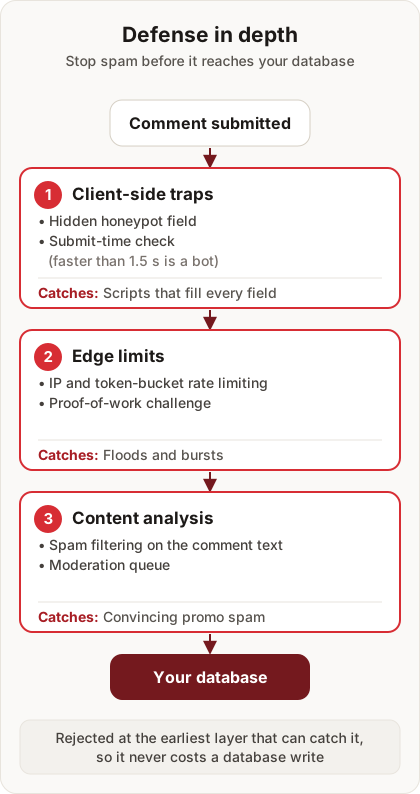
1. Invisible Client-Side Traps (Honeypots and Time-Gated Submission)
Automated scrapers parse static DOM forms and submit data to input fields automatically. Deploy these lightweight defenses:
- CSS-Hidden Honeypot Fields: Add an
<input type="text" name="website_trap" tabindex="-1" autocomplete="off" style="display:none">field. Real human users cannot see or fill this input; any submission containing data in this field is instantly dropped. - Timestamp Fingerprinting: Measure the delta between form mount and form submission. Bot submissions occurring within sub-second thresholds (<1.5 seconds) can be rejected automatically.
2. Edge Rate Limiting and Cryptographic Challenges
Protect public API endpoints against automated floods by enforcing strict IP-based and token bucket rate limiting at the CDN edge. Rather than annoying legitimate users with intrusive visual image CAPTCHAs, implement non-interactive cryptographic Proof-of-Work (PoW) challenges in the background before accepting a POST payload.
3. Modern Spam Filtering and Moderation Tooling
Spam patterns evolve rapidly beyond basic keyword blocklists. Today's spammers deploy automated agents to post context-relevant, conversational spam containing hidden promotional links.
Effective defense requires sophisticated content analysis. EchoThread provides spam and moderation tooling, including AI-assisted spam filtering through its Siftfy integration, rather than a built-in first-party AI moderation engine. To explore how to protect static discussion sections against automated abuse, review our guide on how to stop AI comment spam.
Importantly, spam defense should rarely compromise user privacy. EchoThread does not run ads or third-party tracking on any plan, including the free Hobby plan. This guarantees clean, compliance-ready community management without surveillance monetization.
SSG-Specific Integration Guides and Framework Best Practices
Implementing comment systems varies across modern static web frameworks. Here is how to handle comment threads across the most popular static site generators.
Astro: Component Islands and Deferred Hydration
Astro ships zero client-side JavaScript by default. By utilizing Astro's component island architecture, you can isolate the commenting widget inside a custom component that hydrates only when it enters the reader's viewport. Read our comprehensive Astro integration guide for complete setup instructions.
---
// Comments.astro
interface Props {
  identifier: string;
}
const { identifier } = Astro.props;
---

<div id="echothread-comments" data-identifier={identifier}></div>

<script>
  const initComments = () => {
    const el = document.getElementById('echothread-comments');
    if (!el) return;
    const script = document.createElement('script');
    script.src = 'https://cdn.echothread.io/widget.js';
    script.async = true;
    document.body.appendChild(script);
  };

  // Run only when the document is ready
  if (document.readyState === 'loading') {
    document.addEventListener('DOMContentLoaded', initComments);
  } else {
    initComments();
  }
</script>
Hugo & Jekyll: Front-Matter Partial Integration
For Hugo and Jekyll sites, comment integration uses partial templates injected into the base single-post layout. In Hugo, create layouts/partials/comments.html and reference your front-matter variables. For detailed implementation steps, consult our Hugo integration guide.
<!-- layouts/partials/comments.html -->
{{ if and (not .Params.disable_comments) (ne .Site.Params.comments_enabled false) }}
<section class="comments-section" style="margin-top: 3rem;">
  <div id="echothread-comments"
       data-site-id="{{ .Site.Params.echothread_site_id }}"
       data-identifier="{{ .File.UniqueID }}">
  </div>
  <script src="https://cdn.echothread.io/widget.js" async defer></script>
</section>
{{ end }}
Next.js (SSG / Static Export): Script Optimization
When compiling Next.js applications to static exports (via output: 'export'), manage script execution using the native next/script component with the lazyOnload strategy. Review our step-by-step Next.js commenting guide for advanced patterns.
import Script from 'next/script';

export default function CommentsSection({ postSlug }: { postSlug: string }) {
  return (
    <div className="comments-wrapper mt-12">
      <div id="echothread-comments" data-identifier={postSlug} />
      <Script
        src="https://cdn.echothread.io/widget.js"
        strategy="lazyOnload"
        onLoad={() => {
          console.log('Comments widget loaded smoothly.');
        }}
      />
    </div>
  );
}
Evaluating Platform Costs and Maintenance Overhead
When planning your commenting infrastructure, factor operational scalability into your platform selection. Review the transparent tiers on our pricing page to balance growth requirements.
EchoThread offers a free Hobby plan with usage limits (1 site, unlimited comments; 10,000 page views a month on sites created on or after 1 October 2026, unmetered on sites created before that date) alongside paid Starter, Pro, and Business tiers; it is not unconditionally free forever. The free Hobby plan includes a Powered by EchoThread footer; paid plans remove that branding. EchoThread monetizes through more sites, higher usage headroom, brand removal, and operational controls rather than ads, tracking, or data lock-in. Additionally, EchoThread does not support custom or white-label domains for the embed widget; the widget loads from EchoThread's CDN.
Conclusion: Designing a Scalable, Future-Proof Comment Stack
Handling dynamic comment threads on a static site does not require compromising your site's performance, user privacy, or build pipelines. By adhering to modern architecture patterns—decoupling client-side dynamic state from edge-cached static pages, lazy-loading widgets with IntersectionObserver, and enforcing zero-tracking privacy standards—you can run thriving community discussions while preserving sub-second load times.
Auditing Your Static Site Comment Stack
- Payload Size: Does your commenting script load asynchronously, with no third-party tracking requests?
- Core Web Vitals Impact: Does your container reserve vertical space to prevent layout shifts (CLS < 0.1)?
- Identifier Resilience: Are your thread mappings anchored to permanent unique identifiers rather than mutable URL slugs?
- Spam & Abuse Filtration: Do you have layered anti-spam protections running automatically without intrusive user-facing CAPTCHAs?
- Privacy Standards: Does your commenting provider respect user trust by operating entirely free of ad-tracking pixels and surveillance monetization?
Frequently Asked Questions
Can search engines index dynamic comment threads on a static website?
Yes. Search engines like Google employ a two-phase indexing pipeline. In the second phase, headless Chromium instances render dynamic JavaScript DOM trees. However, because client-rendered content consumes headless rendering budget, ensure your widget mounts cleanly without requiring user interaction clicks to reveal initial text.
How do client-side commenting widgets impact Google Core Web Vitals?
Legacy commenting widgets hurt Core Web Vitals by downloading multiple megabytes of JavaScript, blocking the main browser thread (harming INP), and shifting layouts dynamically (harming CLS). Modern lightweight widgets avoid these penalties by shipping a single dependency-free bundle, loading scripts asynchronously after initial page paint, and assigning fixed min-height rules to parent containers.
What is the difference between static-baked comments and dynamic API-based comments?
Static-baked comments are compiled directly into the HTML file during the static site generator's build step (typically triggered via Git commits or webhooks). Dynamic API-based comments decouple comment storage from page generation, serving the static HTML instantly and fetching user discussions asynchronously over a lightweight JSON API endpoint upon page load.
How can I prevent spam bot submissions on static site comment forms without intrusive CAPTCHAs?
Prevent spam by implementing layered, invisible defenses: CSS-hidden honeypot form fields, submission timing thresholds, edge-level rate limits, and cryptographic background proof-of-work challenges. Pairing these front-end controls with intelligent spam classification APIs filters abusive submissions without forcing human commenters to solve visual puzzle challenges.
Ready to bring fast, privacy-focused discussion threads to your static site? Set up EchoThread on your Astro, Hugo, or Next.js blog in under 5 minutes with our free Hobby plan.
Discussion
Comments
This thread runs on EchoThread — the same widget you would add to your own site.
No comments yet.